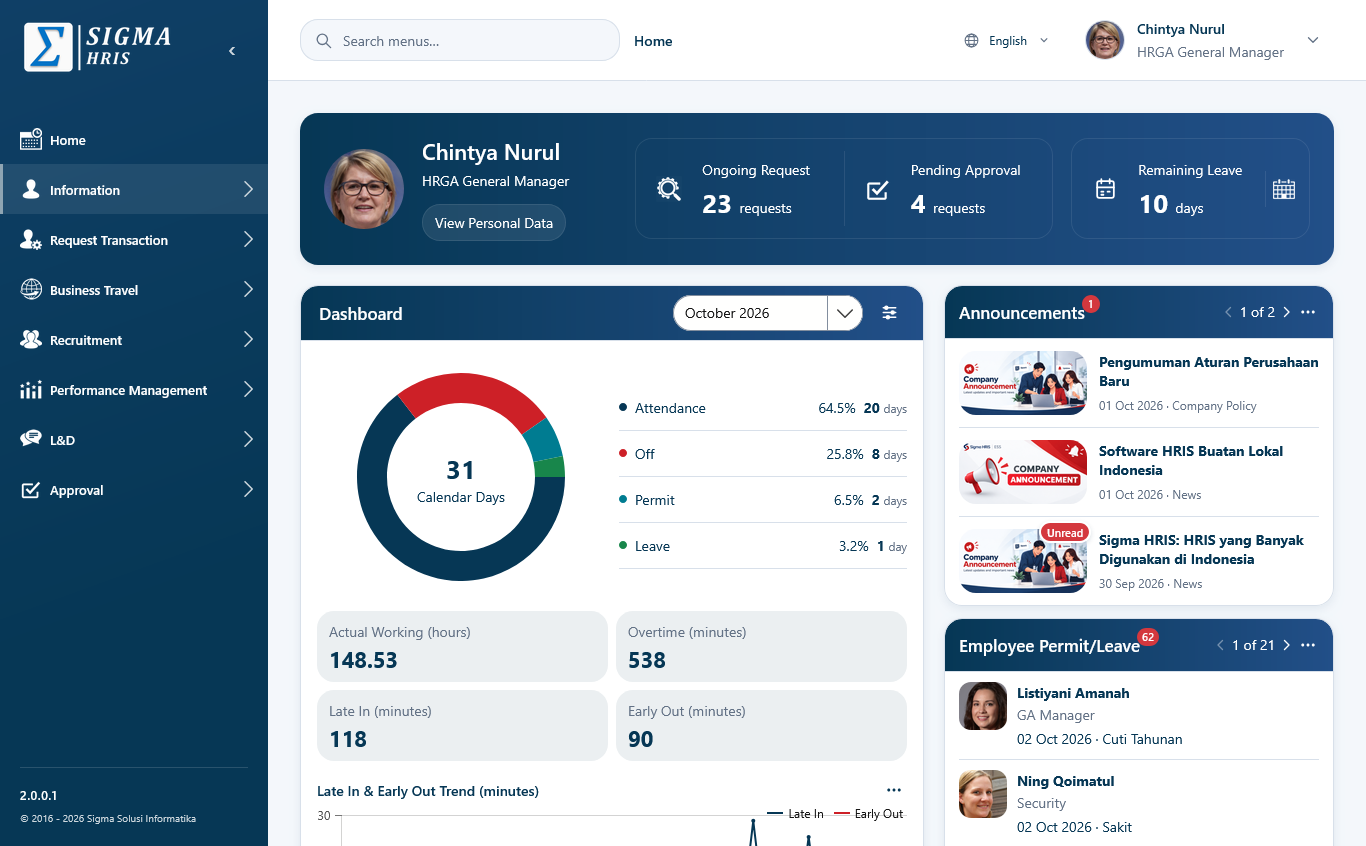
Sigma HRIS is an on-premise HRIS and payroll solution designed for companies in Indonesia—from small businesses to enterprise organizations—requiring a flexible HR system with full data control and no subscription scheme.
HRIS & Payroll Software Indonesia for On-Premise and Cloud Solutions
We provide HRIS and payroll solutions designed for companies in Indonesia, supporting organizations from tens to tens of thousands of employees. Backed by a structured implementation approach and fast-response support. Our applications are built with modern technology, including automation and AI utilization to improve workforce management efficiency.
Our HRIS & Payroll Products
To serve a wide range of business needs, we provide two HRIS and payroll solutions with different approaches—tailored to organizational scale, company policies, and infrastructure readiness. Our systems cover core HR operations such as employee data management, attendance, payroll, PPh 21, and BPJS. They also support strategic HR needs such as business travel, recruitment, performance management, and learning and development. All processes are integrated through Employee Self Service and continuously improved using modern technology, including AI and edge computing, to increase workforce management effectiveness.
Forte HRIS is a cloud-based HRIS and payroll solution for companies in Indonesia—from small businesses to enterprise organizations—requiring a modern and flexible HR system with a cloud apps architecture to support fast operations.
What HR features are available in Forte HRIS?
Is Forte HRIS suitable for growing companies?
What technology stack is used to build Forte HRIS?
How does Forte HRIS integrate with other systems?
What industries use Forte HRIS?
How does Forte HRIS implementation work?
Is support provided for Forte HRIS?
What is the pricing model for Forte HRIS?
Why Our Approach Is Different
Many companies fail in HRIS implementation not because of the technology, but because implementation and support are not consistently available. We take a different approach to ensure your HR system can be adopted, remain stable, and support day-to-day business operations. Through structured implementation, dedicated support for each customer, and a Project Manager who can be contacted to resolve issues, we help ensure the transition is fast and comfortable. The system is also continuously improved so your HRIS stays relevant and can keep up with evolving business needs. With this approach, companies gain peace of mind when switching to our HRIS.
Modular System
Our HRIS is built with a modular concept, enabling companies to choose and use features based on current operational needs. This approach helps companies achieve more efficient HRIS investment. A modular HR system also makes future enhancements easier, stays flexible, and remains relevant as the business grows.
Business Process Mapping
Every HRIS implementation starts with clear business process mapping to produce an HR policy blueprint aligned to the company’s real conditions. This ensures the HRIS follows your workflows—rather than forcing the organization to adjust to the system. With proper mapping, implementation becomes more structured and easier to understand.
Structured HRIS Implementation
HRIS implementation is executed in a structured, phased, and measurable way, with scope, timeline, and outputs agreed from the start. This helps ensure the HR system runs stably when used and reduces the risk of disrupting daily HR operations. A clear process also accelerates go-live and improves user adoption.
Support Assurance
We provide responsive HRIS support that you can reach when needed. Each customer gets dedicated support and a Project Manager who can be contacted to help resolve system issues. This ensures your HR system continues to run well, providing confidence and peace of mind for long-term HRIS usage.
HRIS Implementation Stages
The HRIS implementation process is carried out in structured stages so the HR system can be used stably, aligned to business processes, and ready to support company operations.
Presentation & Demo
An introduction to the HRIS solution through a presentation and system demo to understand features, workflows, and alignment with company needs.
Business Process Requirements
Collecting HR business process requirements to ensure the HRIS aligns with company policies, organizational structure, and operational workflows.
Setup & Configuration
Configuring HRIS modules, data structure, access roles, and system parameters based on agreed business process requirements.
Data Migration
Migrating HR data from the existing system into the new HRIS safely and systematically, so data is ready without disrupting operations.
UAT & Training
User Acceptance Testing to confirm the system meets requirements, followed by admin and user training to prepare the organization to use the HRIS.
Go-Live & Maintenance
The HRIS goes live for full usage, with onboarding assistance, monitoring, and ongoing maintenance to maintain system stability.
A Guide to Choosing the Right HRIS & Payroll System for Your Company
Every company has different needs, policies, and levels of complexity in managing workforce operations and payroll. Therefore, selecting HRIS and payroll software should be evaluated from multiple angles. The right system should adapt to organizational scale, operating model, regulatory complexity, and infrastructure readiness. Choosing the right software helps ensure HR operations run effectively and sustainably.
Service & Support Availability
When choosing HRIS and payroll software, reliable application support is a critical factor. Without clear and responsive support, companies risk operational stagnation because the HR team’s time and energy will be spent repeatedly handling technical issues. Sigma HRIS and Forte HRIS are built with a structured support approach—from dedicated support and clear escalation paths to implementation guidance—so companies are not left to face system issues alone in the long term.
Application Speed That Supports Productivity
Application speed strongly impacts HR team effectiveness. Slow web and mobile systems, long module loading times, or non-responsive processes directly reduce productivity and increase operational workload. Sigma HRIS and Forte HRIS are designed for high performance using modern architectural optimization and state-of-the-art approaches, including novel algorithms developed internally, so HR processes can run faster, more stable, and more efficiently.
Application Architecture That Fits Company Scale
Each company has different needs for data management and IT infrastructure. Companies that require full data ownership typically prefer on-premise systems, while companies prioritizing fast adoption without relying heavily on internal IT can choose a cloud solution. Sigma HRIS and Forte HRIS are developed with flexible architectures to support both approaches, enabling use from small to large-scale organizations.
System Flexibility to Match HR Processes
HR needs in each company are not always the same and can evolve as the organization grows. Therefore, HRIS software should have a high level of flexibility—across module configuration, approval workflows, and policy adjustments. Sigma HRIS and Forte HRIS provide flexible system settings that can be managed independently by the company or with support assistance, so HR processes can keep evolving without disrupting ongoing operations.